GRS-certified recycled PE bags from Vietnam: what GRS really covers
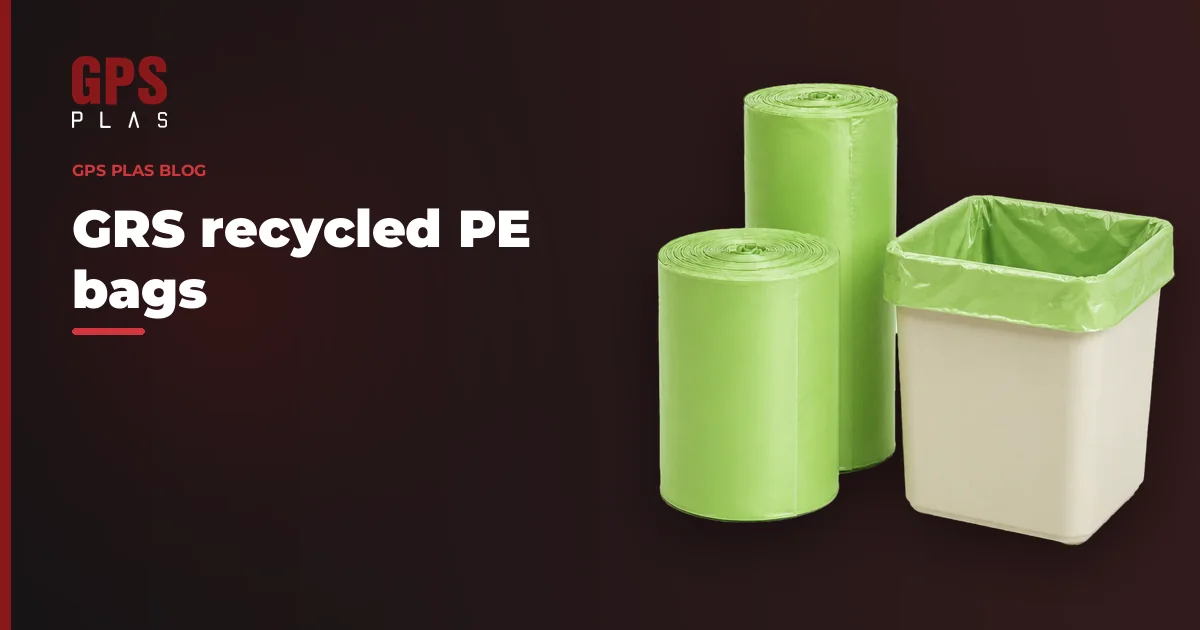
A GRS mark on a Vietnamese factory certificate does not, by itself, certify your bags. GPS PLAS holds a GRS 4.0 scope certificate for recycled PE packing bags and pellets, but a specific order is GRS certified only with a Transaction Certificate. ReFlex is the factory’s recycled PE film and bag range: recyclable, not biodegradable.
What the Global Recycled Standard actually is
The Global Recycled Standard (GRS) is a voluntary standard from Textile Exchange. It verifies recycled content through the full supply chain and adds social, environmental and chemical requirements. That combination is the point. Recycled content on a packing slip is not the same as recycled content that has been checked from the pellet to the printed bag, under a third-party scheme.
GRS is widely used for textiles, but the standard also covers products such as packing bags and recycled pellets when they sit in a certified scope. That is the case at GPS PLAS. The certification body on the factory certificate is IDFL. The standard version is GRS 4.0.
If you only need a recycled-content number, you still have work to do: you must say whether that number is pre-consumer, post-consumer, or a mix, and you must decide whether your customer will accept a supplier declaration or will require a chain-of-custody document. GRS is built for the second of those two paths.
What the GPS PLAS scope certificate covers
The factory certificate is a scope certificate. It says which legal entity, which site, which processes and which product types are certified. It is not a shipping document.
For GPS PLAS the published details are:
- Standard: GRS 4.0
- Certification body: IDFL
- Certificate ID: IDF-26-1034337
- Valid until: 15 October 2027
- Products in scope: packing bags and pellets from pre- and post-consumer recycled PE
- Processes in scope: extrusion, manufacturing, printing
- Site: the GPS PLAS factory in Long Hau Extended Industrial Park, Tay Ninh
That list is specific. BioFlex and CompoFlex have their own claims (biodegradable and compostable). The Recycled grade of BioFlex does use GRS recycled PE compounded with TPS, and is described as GRS certified, but ReFlex itself is sold as film and bags, not as a resin.
GRS: two documents, two jobs
A factory scope certificate is not proof for a shipment.
Scope certificate
The factory is certified
Shows which site, processes and product types sit under GRS.
GPS PLAS example
GRS 4.0 · IDFL · IDF-26-1034337
Recycled pre- and post-consumer PE packing bags and pellets
Extrusion, manufacturing, printing
Valid until 15 October 2027
Transaction Certificate
This shipment is certified
Issued for a specific order or shipment. This is the document that proves GRS recycled content for those goods.
Ask for a GRS TC with your quote.
Without a TC, the factory certificate alone does not certify the goods.
Scope certificate versus Transaction Certificate
This is the distinction buyers miss most often, and GPS PLAS states it plainly: a GRS factory certificate is not proof for a shipment. Goods are proven GRS only with a Transaction Certificate (TC) for that shipment. Ask for the TC with your quote.
A practical way to use the two documents:
- The scope certificate tells you the factory is allowed to make GRS goods of a stated type, at a stated site, until a stated date. Check the name, the address, the product description, the processes and the expiry date.
- The Transaction Certificate tells you that a given order or shipment was made and sold as GRS, with the recycled-content claim that applies to those goods.
If you put “GRS certified bags” on a retail pack, a tender or an import file, you need the second document, not only a PDF of the first. GPS PLAS even offers a quote route labelled for a GRS transaction certificate, and a sample request for ReFlex.
What ReFlex is, and what it is not
ReFlex is recycled PE film and bags made by GPS PLAS in Vietnam. It is made with GRS-certified recycled PE, from 10 to 100% recycled content. The factory describes ReFlex as post-consumer waste recycled PE. It is recyclable again after use. It is not biodegradable. That last sentence is not a minor disclaimer. Recycled PE remains PE. Do not print a biodegradation or compostable claim on a ReFlex bag.
ReFlex also holds Vietnam Ecolabel certificate VN-ECO-2025-012. Under criteria NSTVN-01:2023, recycled PE or PP bags need at least 20% recycled resin, a thickness of 50 µm or more, and each side of at least 50 cm. Those size and thickness rules are meant for a thicker, larger bag that can be reused many times. If you need a very thin vest bag, the Ecolabel path may not be the right one; discuss the format with the factory rather than stretching the claim.
The site also states a lower carbon footprint of 5 to 50% for ReFlex, from using less virgin PE. Treat that as a range the factory publishes, and ask for the basis that applies to your specification. It is not a single number for every bag.
Pre-consumer, post-consumer and PCR
GRS can cover both pre-consumer and post-consumer recycled input, and the GPS PLAS scope lists both. They are not the same thing, and many brand targets count only post-consumer material (PCR).
- Pre-consumer material comes from factory scrap that never reached a user.
- Post-consumer recycled (PCR) material comes from used products collected after disposal.
GPS PLAS describes ReFlex as post-consumer waste recycled PE, while the scope certificate also names pre-consumer recycled PE. If your policy allows only PCR, write that into the brief and ask the factory to confirm the input for your order on the Transaction Certificate. Do not assume the word “recycled” on a datasheet meets a PCR-only target.
Recycled is also not the same as recyclable. Recycled content is the share of recycled resin already in the product, verified through the supply chain by GRS. Recyclable describes what can happen after use. ReFlex is both recycled (in the content you specify) and recyclable. It is still not biodegradable.
What GPS PLAS makes with ReFlex
ReFlex is supplied as film on roll or as finished bags, printed up to 4 colours. Formats offered in ReFlex, alongside BioFlex and CompoFlex, include T-shirt bags, die-cut bags, shopping bags, cup bags and carriers, bags on roll, waste bags, dog poop bags, poly bags, mailer bags, VCI anti-corrosion bags, ESD anti-static bags and film on roll. Grow bags, grow pot bags, mulching film and shrink film are CompoFlex only, not ReFlex.
If you also need a biodegradation claim, look at BioFlex Recycled, which compounds GPS PLAS TPS with GRS recycled PE: 0% virgin PE, a 55 to 70% lower carbon footprint as published by the factory, and a biodegradation test behind it. That is a different product, with a different claim, and it still should not be called compostable.
The same factory also holds ISO 9001:2015 (certificate HT 3883) and ISO 14001:2015 (certificate HM 640). Those management-system certificates belong in the due diligence file many buyers attach to a first order. When you check the GRS file, compare the legal name (Công ty TNHH Nhựa GPS / GPS PLAS), the Tay Ninh site, the product description (packing bags and pellets), the processes (extrusion, manufacturing, printing) and the 15 October 2027 expiry with what you are being offered. If any of those do not match, ask before you print a claim.
To go further, read how to choose recycled, biodegradable or compostable bags, or request ReFlex samples and a quote with a GRS Transaction Certificate.
FAQ
Is GPS PLAS GRS certified?
Yes. The factory holds GRS 4.0 scope certificate IDF-26-1034337, issued by IDFL, valid until 15 October 2027. The scope covers packing bags and pellets from pre- and post-consumer recycled PE, with extrusion, manufacturing and printing.
Does a factory GRS certificate certify my order?
No. A GRS factory certificate is not proof for a shipment. Goods are proven GRS only with a Transaction Certificate (TC) for that shipment. Ask for a TC with your quote.
Is ReFlex biodegradable?
No. ReFlex is recycled PE film and bags. It is recyclable after use, not biodegradable. Never describe ReFlex as biodegradable.
What recycled content can ReFlex be made with?
ReFlex is made with GRS-certified recycled PE, from 10 to 100% recycled content. The Vietnam Ecolabel for recycled PE or PP bags (criteria NSTVN-01:2023, certificate VN-ECO-2025-012) requires at least 20% recycled resin, a thickness of 50 µm or more, and each side of at least 50 cm.
What is the difference between pre-consumer and post-consumer recycled plastic?
Pre-consumer material comes from factory scrap that never reached a user. Post-consumer recycled (PCR) material comes from used products collected after disposal. Many brand targets count only PCR, so always ask which kind. GPS PLAS describes ReFlex as post-consumer waste recycled PE, and the GRS scope also covers pre-consumer recycled PE.