Biodegradable PE-TPS bags: what they are, where they work, and the claims you can make
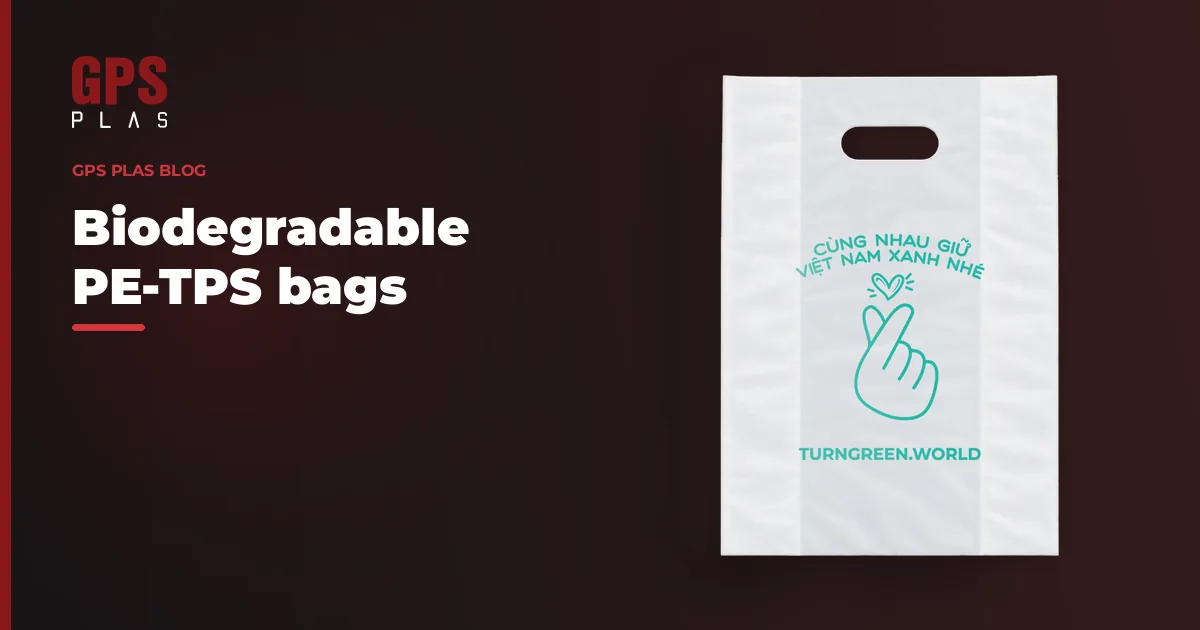
BioFlex is a PE-TPS resin made by GPS PLAS in Vietnam: polyethylene compounded with thermoplastic starch from corn and cassava. It is fully biodegradable. It passed EN ISO 14855-1 in 227 days. Because 227 days is longer than the 180 days allowed by EN 13432, BioFlex is not sold as compostable. The claim you can print is the one the test supports.
What PE-TPS is, and why GPS PLAS makes its own TPS
PE-TPS is a compound of polyethylene and thermoplastic starch, supplied as pellets for film blowing. Thermoplastic starch (TPS) is starch processed so it melts and flows like a plastic. GPS PLAS makes its TPS from corn and cassava starch. The factory says the purity of that TPS lets film keep partial transparency, and cassava gives a clean hand feel.
Compounded with polyethylene, TPS improves the flexibility and elongation of PE. The key benefit GPS PLAS highlights is complete biodegradation, because microorganisms can consume this modified material. It can be processed on standard PE lines as a drop-in solution. That last point matters for converters: you are not being asked to rebuild a film line in order to trial the resin.
GPS PLAS describes BioFlex as Vietnam’s first PE-TPS compounded biodegradable resin. The company has compounded and converted in Tay Ninh since 2017. You can buy the resin, film on roll, or finished bags from the same plant.
Three BioFlex grades
Every grade uses 10 to 40% TPS. The difference is the polyethylene next to the starch:
- BioFlex Standard: virgin PE + TPS. Reduced fossil material, a 10 to 40% lower carbon footprint as published by the factory, and TÜV AUSTRIA OK biobased.
- BioFlex Recycled: GRS recycled PE + TPS. 0% virgin PE, a 55 to 70% lower carbon footprint as published by the factory, TÜV AUSTRIA OK biobased, and GRS certified.
- BioFlex Renewable: green PE + TPS, using Braskem green PE, again with TÜV AUSTRIA OK biobased.
OK biobased on BioFlex is described as one star, 20 to 40% biobased carbon. That is a biobased-carbon mark, not a compostable mark and not a recycled-content mark. Keep the labels separate on artwork and in tenders.
Common to every grade: more than 3 years of storage time, and a translucent film with colours possible. Resin is packed in 25 kg vacuum-sealed bags, each in a carton box, in a film grade (TPS + PE) and an injection grade (TPS + PP). Film is blown on roll to your width and thickness. Finished bags are converted and printed in the factory, up to 4 colours.
The claim you can make, and the claims you should not make
EN ISO 14855-1 measures how much of the material’s carbon microorganisms convert to CO2 in a controlled compost environment. Passing means the material was broken down by biology, not crumbled into smaller pieces. BioFlex passed that test in 227 days, in a report by ARCHA. The wording GPS PLAS uses is exact: “Fully biodegradable: passed EN ISO 14855-1 in 227 days.”
Use that wording, or wording that does not go further than the test. Real-world times still depend on the environment, temperature and moisture. A laboratory pass is not a promise of 227 days in every soil, landfill or litter scene.
Claims you can make for BioFlex
Say the standard and the number of days.
Biodegradable
Microorganisms convert the material into CO2, water and biomass. BioFlex passed this test in 227 days (ARCHA).
Not compostable
EN 13432 requires a pass within 180 days. 227 days is a biodegradation pass and a miss for the compostable label. If the bag must be compostable, choose CompoFlex.
Not oxo-degradable
Oxo bags fragment into small plastic pieces. EN ISO 14855-1 measures conversion by microorganisms, not crumbling.
What you should not do:
- Do not call BioFlex compostable. EN 13432 requires a biodegradation pass within 180 days. 227 days is a pass for biodegradation and a miss for the compostable label. If the bag must be compostable, choose CompoFlex.
- Do not treat BioFlex as an oxo or “túi tự hủy” bag. Oxo bags fragment into microplastics. The EN ISO 14855-1 result measures conversion into CO2 and biomass by microorganisms, not fragmentation.
- Do not call ReFlex biodegradable. ReFlex is recycled PE, recyclable after use, not a biodegradation grade.
TÜV AUSTRIA OK biobased can be used for the grades that hold it, with the one-star, 20 to 40% biobased carbon range published for those grades. The Recycled grade can also carry a GRS claim, and a GRS claim on goods still needs a Transaction Certificate for the shipment, as explained in the GRS guide.
Where BioFlex bags work
BioFlex is aimed at flexible film that must be strong, printable and keep a long shelf life. Thanks to its durability, it works where compostable plastics do not last long enough in use. The factory contrasts the two ranges directly: CompoFlex is the answer when the bag must be compostable, for example for food-waste collection or a market that demands EN 13432. BioFlex is the answer when you need a long shelf life for products that extend over 12 months. Storage time for BioFlex is more than 3 years, against 9 to 12 months for CompoFlex.
Finished BioFlex bags can include the same core formats as the rest of the range: T-shirt bags, die-cut and shopping bags, cup bags, bags on roll, waste bags, poly bags, mailers, and VCI or ESD packs. Grow bags, grow pot bags, mulching film and shrink film remain CompoFlex only.
Because BioFlex can run as a drop-in on standard PE lines, converters who already blow PE can trial it as resin or as film on roll before they commit to a printed bag. GPS PLAS often sends samples of BioFlex and CompoFlex side by side so you can test both on your line and in your packing environment.
Those formats cover the same industries as the wider GPS PLAS catalogue: retail and food-service bags at the checkout, bags on roll, e-commerce mailers and garment polybags, and manufacturing packs that need VCI or ESD. What changes is the claim you can put on the pack, and how long the bag can sit before use. A mailer or a garment polybag that must remain strong for many months in a warehouse is a typical BioFlex brief. A food-waste bag that must meet EN 13432 is not.
The carbon-footprint ranges published for the grades (10 to 40% lower for Standard, 55 to 70% lower for Recycled) are factory figures for those formulations. Ask for the basis that applies to the specification you will buy. They are not a single number for every thickness and print. The same discipline applies to biobased carbon: use the OK biobased range the certificate covers, and do not upgrade one star into a stronger claim.
BioFlex is compounded in the same 5,000 m² Tay Ninh factory that blows the film and makes the bags, from granules to finished bags. You can start with 25 kg resin bags for a line trial, then move to film on roll or a printed bag when the trial holds. For samples, write to info@gps-plas.com or use the contact form.
A first trial does not have to settle every artwork detail. Many buyers test natural or a single colour first, then add print of up to 4 colours once the film behaves on their line. Keep the claim on the bag aligned with the test report you have in hand, and send that report with the sample request so both sides are looking at the same grade.
If you are choosing between the three material families, read recycled, biodegradable or compostable. To trial BioFlex, request a sample and ask for the EN ISO 14855-1 report with the grade you want.
FAQ
What is PE-TPS resin?
PE-TPS is a compound of polyethylene and thermoplastic starch, supplied as pellets for film blowing. BioFlex is the PE-TPS resin made in Vietnam by GPS PLAS, using TPS from corn and cassava starch.
Is BioFlex compostable?
No. BioFlex passed EN ISO 14855-1 in 227 days, which is beyond the 180-day limit in EN 13432. It is fully biodegradable, and GPS PLAS describes it only that way. If the bag must be compostable, choose CompoFlex.
How long does BioFlex take to biodegrade?
It passed EN ISO 14855-1 in 227 days under controlled composting conditions. Real-world times depend on the environment, temperature and moisture.
How is PE-TPS different from oxo-degradable plastic?
Oxo bags fragment into microplastics. BioFlex passed EN ISO 14855-1 in 227 days, a test that measures conversion into CO2 and biomass by microorganisms, not fragmentation.
What BioFlex grades are available?
Three grades, each with 10 to 40% TPS: BioFlex Standard (virgin PE + TPS), BioFlex Recycled (GRS recycled PE + TPS, 0% virgin PE) and BioFlex Renewable (green PE + TPS, using Braskem green PE). All carry TÜV AUSTRIA OK biobased, and the Recycled grade is also GRS certified.
Who makes PE-TPS resin in Vietnam?
GPS PLAS, a TURN GREEN member, created Vietnam's first PE-TPS compounded biodegradable resin, sold as BioFlex.