From granules to finished bags: why vertical integration matters
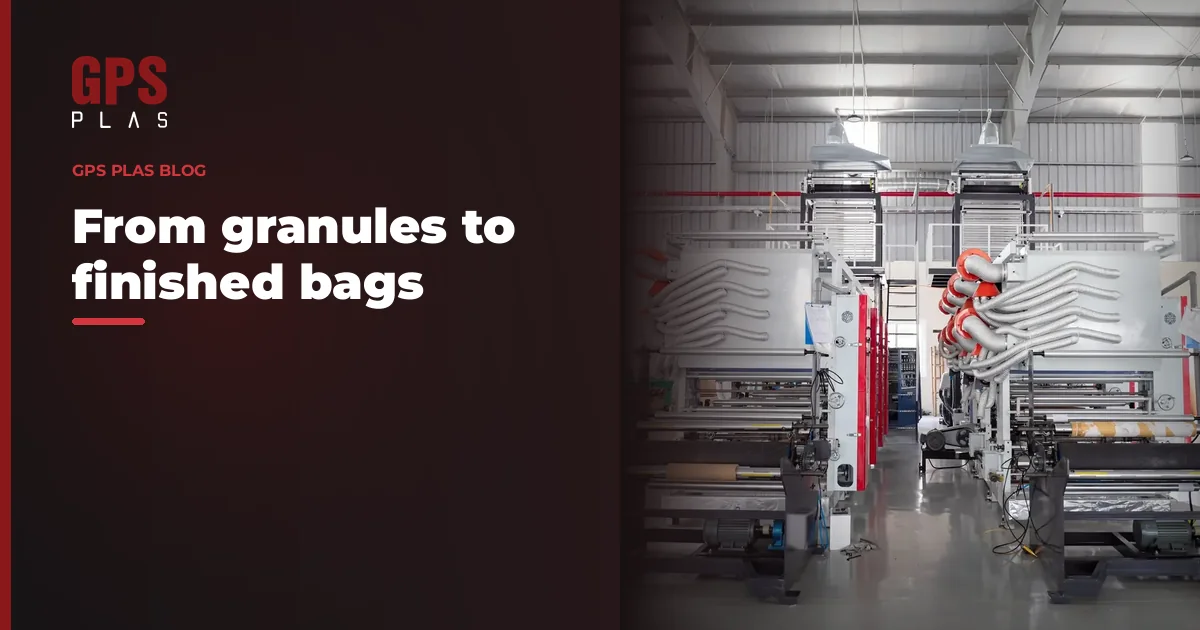
GPS PLAS compounds biopolymers and PCR GRS plastic granules to produce films and bags in a single factory in Tay Ninh, from plastic granules to finished bags. That vertical integration is not a slogan on a brochure. It is why a custom bag, a material claim and a traceability document can be handled by one plant, instead of a resin supplier, a film blower and a bag converter working from separate files.
What 3C means in the factory
The company describes its model as 3C: compounding, converting and customizing, under one roof.
Compounding is the resin step. GPS PLAS formulates and compounds TPS from corn and cassava starch, BioFlex and CompoFlex compounds, and it processes PCR GRS plastic granules for ReFlex film and bags. Functional additives can be compounded in when needed, including anti-static (ESD), VCI anti-corrosion, UV-resistant and shrink grades. The formula can be set for an application or for a regulation, rather than taken as a generic off-the-shelf pellet with no link to the bag that will be printed.
Converting is film blowing, bag making and printing on the factory’s own lines. This is where pellets become film on roll, and where film becomes a T-shirt bag, a mailer, a polybag or a die-cut carry bag.
Customizing is the order-by-order layer: size, thickness, colour and print up to 4 colours, made to your specification. Resins can also be designed for a specific use. The company says full control means high flexibility and a short lead time. It does not publish a standard lead time in days, because that still depends on the job.
From granules to finished bags
3C vertical integration in one Tay Ninh factory.
01
Compounding
TPS from corn and cassava, BioFlex and CompoFlex compounds, PCR GRS PE.
Formulas for the application or the regulation.
02
Converting
Film blowing, bag making and printing on our own lines.
Buy resin, film on roll, or finished bags from the same factory.
03
Customizing
Size, thickness, colour and print up to 4 colours.
Full control means high flexibility and a short lead time.
You do not have to buy the finished bag. You can purchase resin, film on roll or converted bags. BioFlex and CompoFlex are sold in all three forms. ReFlex is sold as film and bags, not as a resin. That choice is useful when you already have converting capacity, or when you want to trial a pellet on your own line before you commit to artwork.
Quality: one recipe, one set of lines, one set of certificates
When compounding and converting are split across companies, a quality problem has several places to hide. A bag may fail a seal test because the film was blown from a slightly different lot than the one in the resin certificate, or a printed claim may not match the grade that actually went into the extruder. In one factory, the people who set the formula also see the film and the finished bag.
GPS PLAS backs that model with factory management-system certificates: ISO 9001:2015 (HT 3883, valid to 5 February 2029) and ISO 14001:2015 (HM 640, valid to 26 February 2029). Material claims sit on top of that, with test reports you can request by grade: EN ISO 14855-1 for BioFlex (ARCHA, 227 days) and for CompoFlex (TÜV Rheinland, within the EN 13432 window), plus Vietnam Ecolabel decisions for ReFlex and CompoFlex, TÜV AUSTRIA OK biobased for BioFlex, and TÜV AUSTRIA OK compost HOME for CompoFlex Home.
The plant and R&D centre covers 5,000 m² at Long Hau Industrial Park, near Ho Chi Minh City, Vietnam. Capacity is 500 tons per month across compounding, film blowing, printing and bag making. Founded in 2017, the factory positions itself as a pioneer of PE-TPS compounding in Vietnam, and as a first mover in supplying large supermarket, garment and industrial bakery programmes, as well as eco-friendly VCI and ESD films. Those “firsts” are company statements, not a list of named customers.
Cost and flexibility, without a published price list
GPS PLAS does not publish prices. Each quote depends on the specification: format, size, thickness, print, material and volume. Vertical integration still changes the cost conversation, because you are not paying three margins to three plants for a bag that started as a custom compound. You can also change a formula, a thickness or a print without sending the job back down a chain of subcontractors.
Flexibility is the other half of that story. A short lead time is easier to promise when the resin does not have to travel to a second factory to become a bag. The company states that advantage clearly, and then leaves the actual calendar to the quote. If timing is critical, put the first ship date in the brief and ask the plant to confirm it, rather than assuming a published standard exists.
Printing up to 4 colours, custom widths and thicknesses, and functional films (VCI, ESD, UV-resistant, shrink) are all part of that in-house list. Grow bags, grow pot bags, mulching film and shrink film remain CompoFlex only; everything else in the standard bag list can be quoted in ReFlex, BioFlex or CompoFlex.
Traceability, especially for GRS
Traceability is where vertical integration is hardest to replace. The GPS PLAS GRS 4.0 scope certificate (IDFL IDF-26-1034337, valid to 15 October 2027) covers packing bags and pellets from pre- and post-consumer recycled PE, and it names extrusion, manufacturing and printing as processes in scope. Those are the converting steps. When they happen in the same certified plant that handles the recycled input, the chain of custody has fewer hand-offs.
A scope certificate still does not certify a shipment. A specific order is GRS certified only with a Transaction Certificate. That TC is the document your customer, auditor or customs file will ask for. It is more straightforward to issue when the goods did not leave the certified site between pellet and printed bag. The same logic helps when a buyer wants the matching test report, TDS, MSDS or COA for the exact grade in the order: one factory can pull the file that belongs to that lot.
If you need a GRS claim, say so in the quote request and ask for the TC. The longer explanation sits in the guide to what GRS really covers.
How to use a vertically integrated factory
The site is close enough to Ho Chi Minh City for visits and sample collection, while still sitting in an industrial park in Tay Ninh. If you want to see compounding and converting on the same floor, ask when you request a sample. A visit is not required to place a first order, but it is often the fastest way to settle questions about print, thickness, packing and which documents will travel with the goods.
Start with a brief: bag format, size, thickness, print, material or required claim, and destination market. Request a sample, and ask for the reports that belong to that grade. You can write to info@gps-plas.com or call +84 774 833 230. If you are still choosing a claim, use the material selection guide first, then come back to the plant with one or two grades to trial.
Vertical integration keeps the granules, the film and the finished bag inside one factory that can stand behind all three.
FAQ
What does vertical integration mean at GPS PLAS?
The factory compounds resins and converts them into film and bags on the same site in Tay Ninh. The company calls this 3C: compounding, converting and customizing, from plastic granules to finished bags.
Can I buy only resin, or only film, rather than finished bags?
Yes. You can buy TPS, BioFlex and CompoFlex resins, film on roll, or finished bags. ReFlex is sold as film and bags, not as a resin.
How does vertical integration help GRS traceability?
Extrusion, manufacturing and printing all sit inside the GPS PLAS GRS 4.0 scope certificate (IDFL IDF-26-1034337). A shipment is still GRS certified only with a Transaction Certificate for that order, which is easier to issue when the steps happen in one certified plant.
Does GPS PLAS publish prices or standard lead times?
No. The company does not publish prices because each quote depends on the specification. It says full control means high flexibility and a short lead time, but it does not publish a standard number of days.
Where is the factory and how large is it?
The factory and R&D centre covers 5,000 m² at Long Hau Industrial Park, near Ho Chi Minh City, Vietnam. Capacity is 500 tons per month. The company was founded in 2017.